
A MINI that drives itself sometimes, and the handover that makes it work
MINI Vision Semi-Auto was a BMW-sponsored vision for conditional (SAE Level 3) automation: an interior with two modes, a shared hemispheric interface, and a choreographed handover between driver and car. In 2026 I rebuilt the handover as an interactive prototype and checked the concept against the MINI that BMW actually shipped.
I bet on a round centre as MINI's main interface, and on highway-only autonomy. MINI now ships a round OLED that replaces the cluster, and Level 3 arrived on highways only.1,4 Where it got harder than I forecast: the handover itself. BMW is stepping its 7 Series back from Level 3 to Level 2.6
Keep MINI playful when the car can drive
How can a brand evolve its identity in the connected-car era?
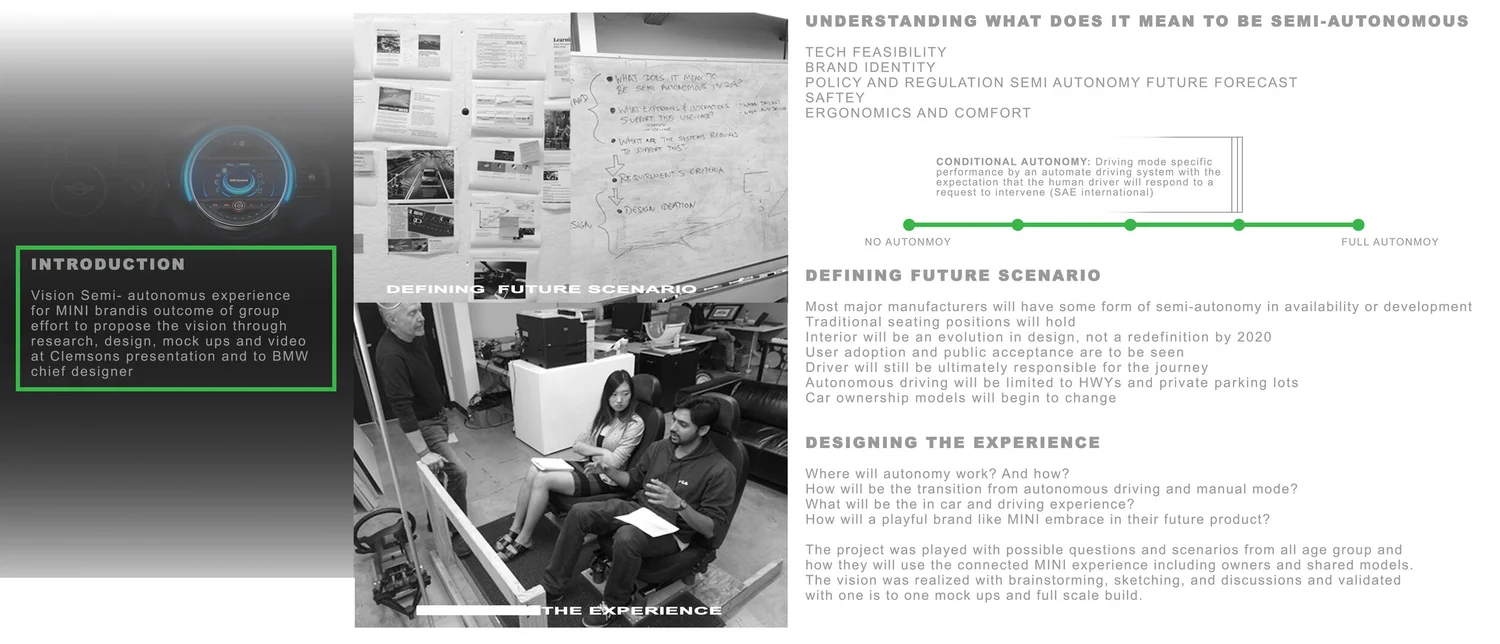
MINI is a brand about the fun of driving. Semi-autonomy asks the opposite: sometimes, let the car drive. I wrote the brief to find out what a MINI is for when the driver isn't driving, and how the car hands control back without killing the fun.
Autonomy stays on the highway
Self-driving would be limited to highways and private parking, and the driver would stay responsible for the journey.
Evolution, not reinvention
Traditional seating holds. The interior changes in degrees, so both modes must live in one cabin.
Transitions are the product
The questions that mattered were where autonomy works, and how the car moves between manual and automated driving.
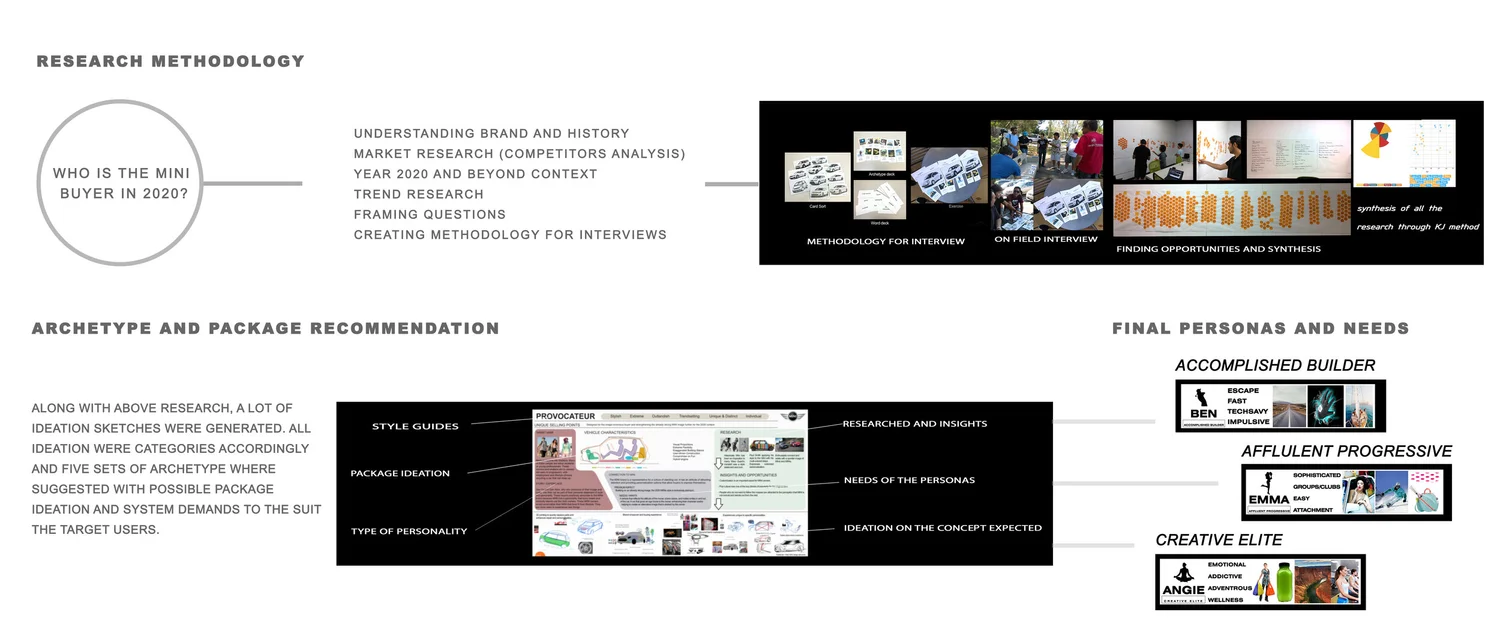
Who is the MINI buyer in 2020?
We studied the brand's history, competitors and trends, then interviewed people in the field and synthesised what we heard into three archetypes. Each archetype came with a package of features and the system demands behind it.
Ben
Wants to escape the commute without giving up control or the feeling of driving well.
Emma
Sophisticated and connected. Expects the car to fit a busy life and to know her schedule.
Angie
Emotional and adventurous. Values wellbeing, and sees the car as part of a community.
Brand and history
What makes a MINI a MINI, from the classic Mini to the connected era.
Market and trends
Competitor analysis and a 2020-and-beyond context for policy, safety and technology.
Field interviews
A methodology and framing questions built for owners and shared-car users of all ages.
Synthesis
Affinity mapping into opportunities, archetypes and feature packages.
What the interior does, and why
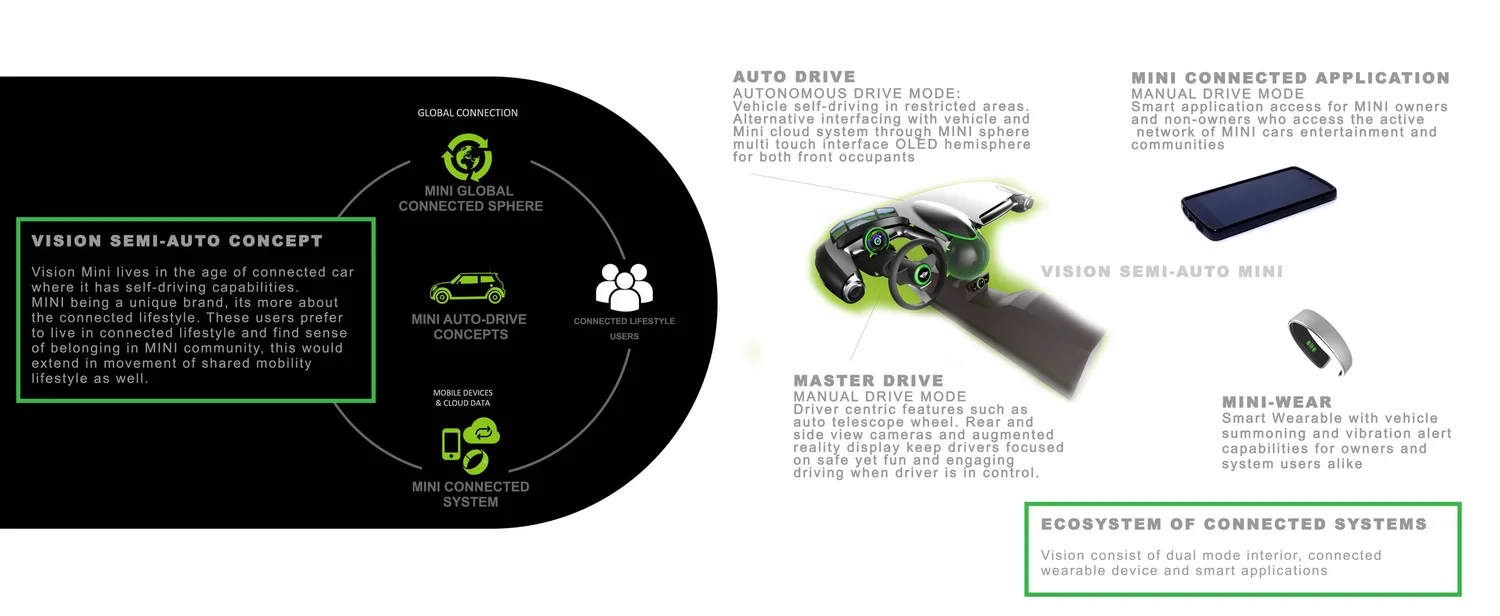
Master Drive and Auto Drive
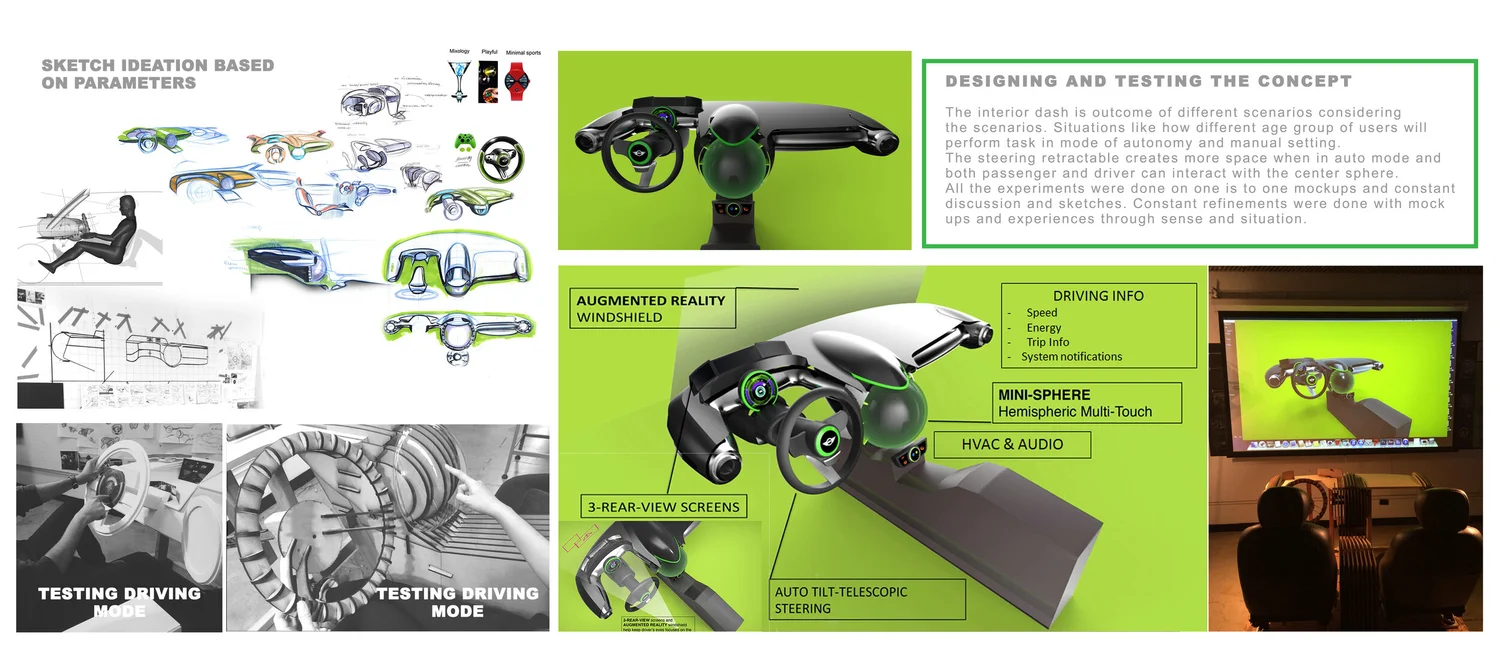
In Master Drive the cabin is built around the driver: a tilt-telescopic wheel, three rear-view screens and an augmented-reality windshield. In Auto Drive the wheel retracts, opening space so the driver and passenger can both reach the centre.
A round centre both people can use
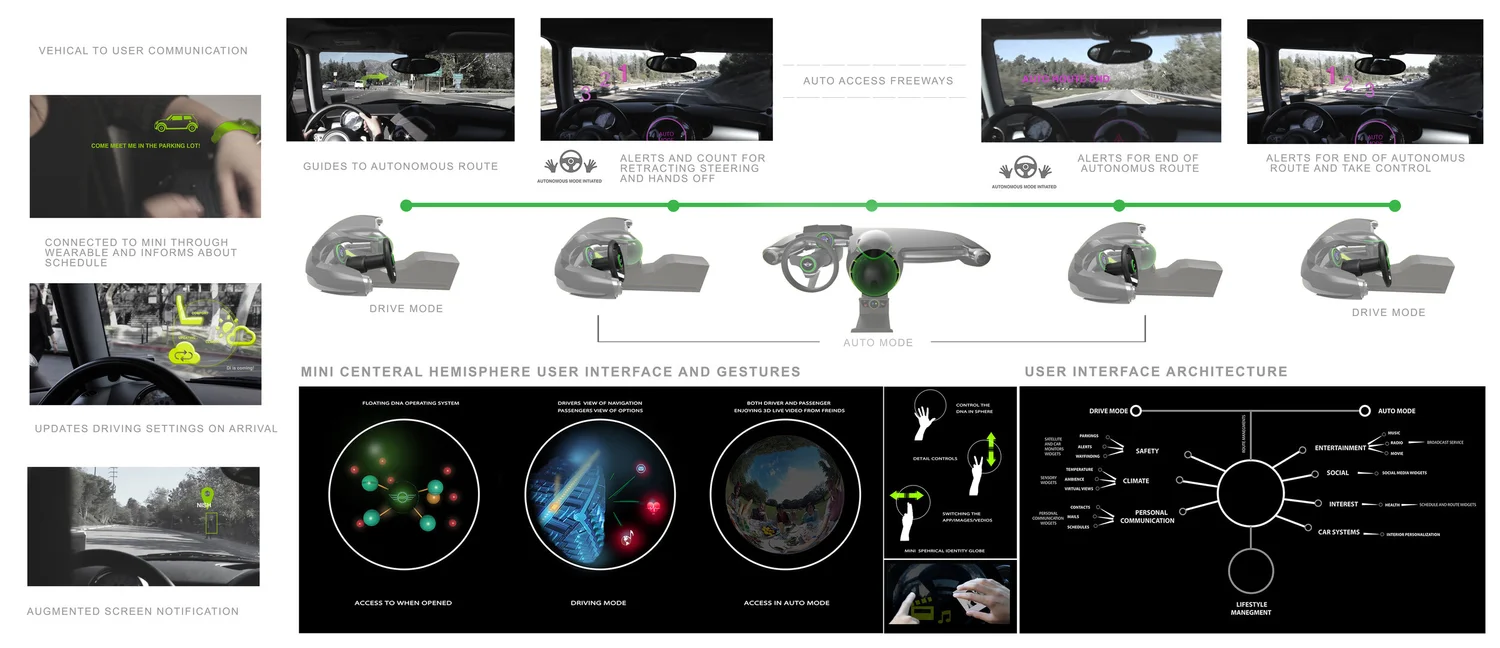
MINI's round centre display became a hemispheric multi-touch interface with its own gestures. It adapts to the mode: driver-focused when driving, shared between both front seats in Auto Drive.
Choreograph every change of control
The car guides the driver to an autonomous route, counts down before the wheel retracts and hands come off, then alerts before the route ends so the driver can take control back. Each step has a cue in the driver's line of sight.
A connected ecosystem
A MINI app for owners and non-owners, and a MINI-Wear band that can summon the car and alert by vibration. The car syncs with the owner's schedule and updates driving settings on arrival.
Full-scale buck, real scenarios
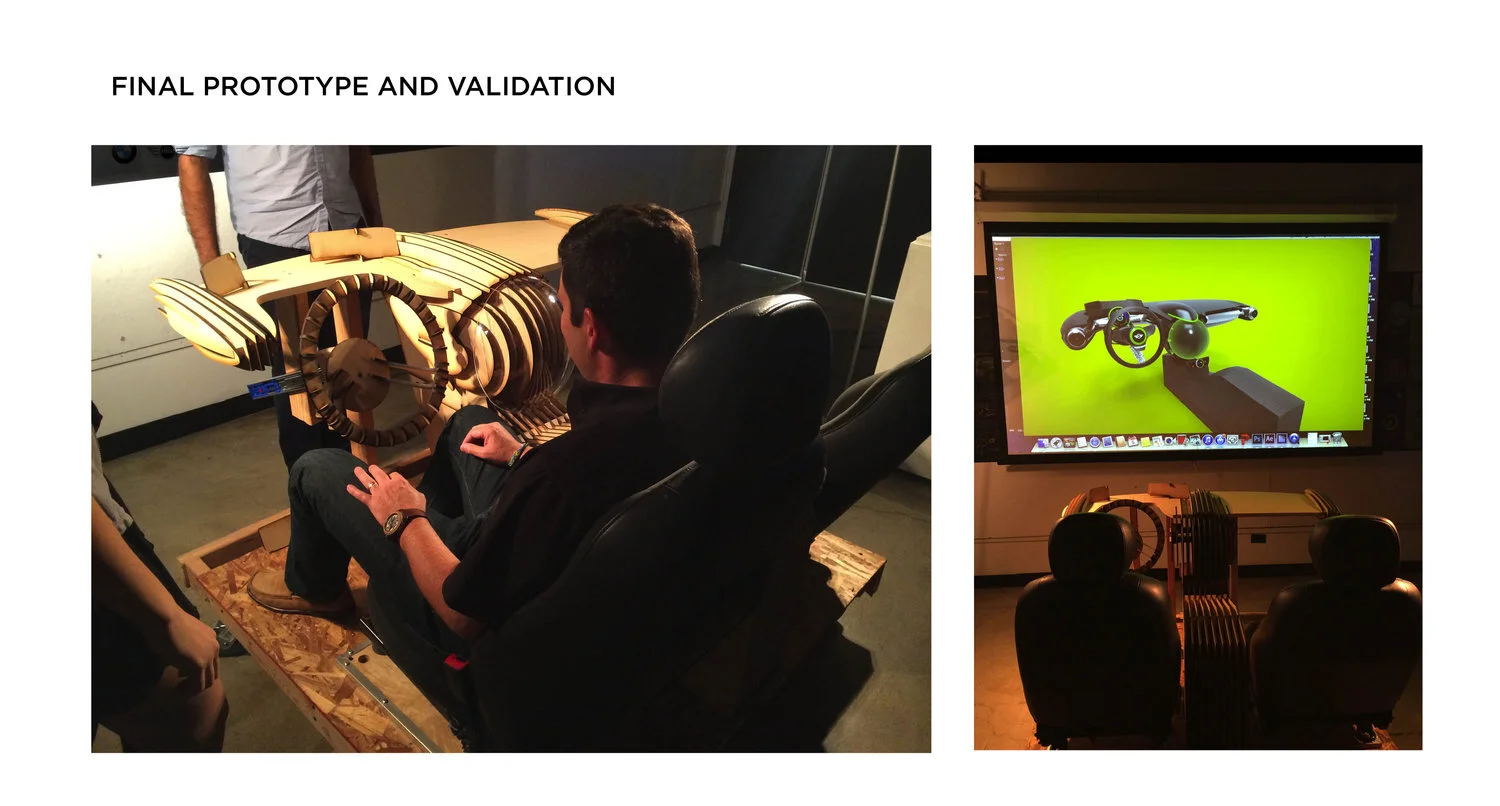
We played through scenarios with people of different ages, owners and shared-car users, in one-to-one mockups and a full-scale buck in front of a projected drive. The dash was refined through sketches, discussion and repeated sessions.
The handover, rebuilt as something you can step through
The 2015 boards show the sequence as stills. Here it runs: what the driver sees ahead, what the MINI-Sphere shows, and where the wheel is at each stage. Switch to the 2026 version to see what I'd change with today's knowledge.
- Driver sees
- MINI-Sphere
Readiness, not just a timer
The 2026 version checks eyes and hands with a driver-monitoring camera before handing control back.
2015: a countdown aloneA fallback if the driver doesn't respond
The car slows to a controlled stop, as production Level 3 systems do.4
2015: not designedSpeed never leaves the driver's view
Driving info stays in the windshield in every mode, while the sphere changes role.
2015: same, and still right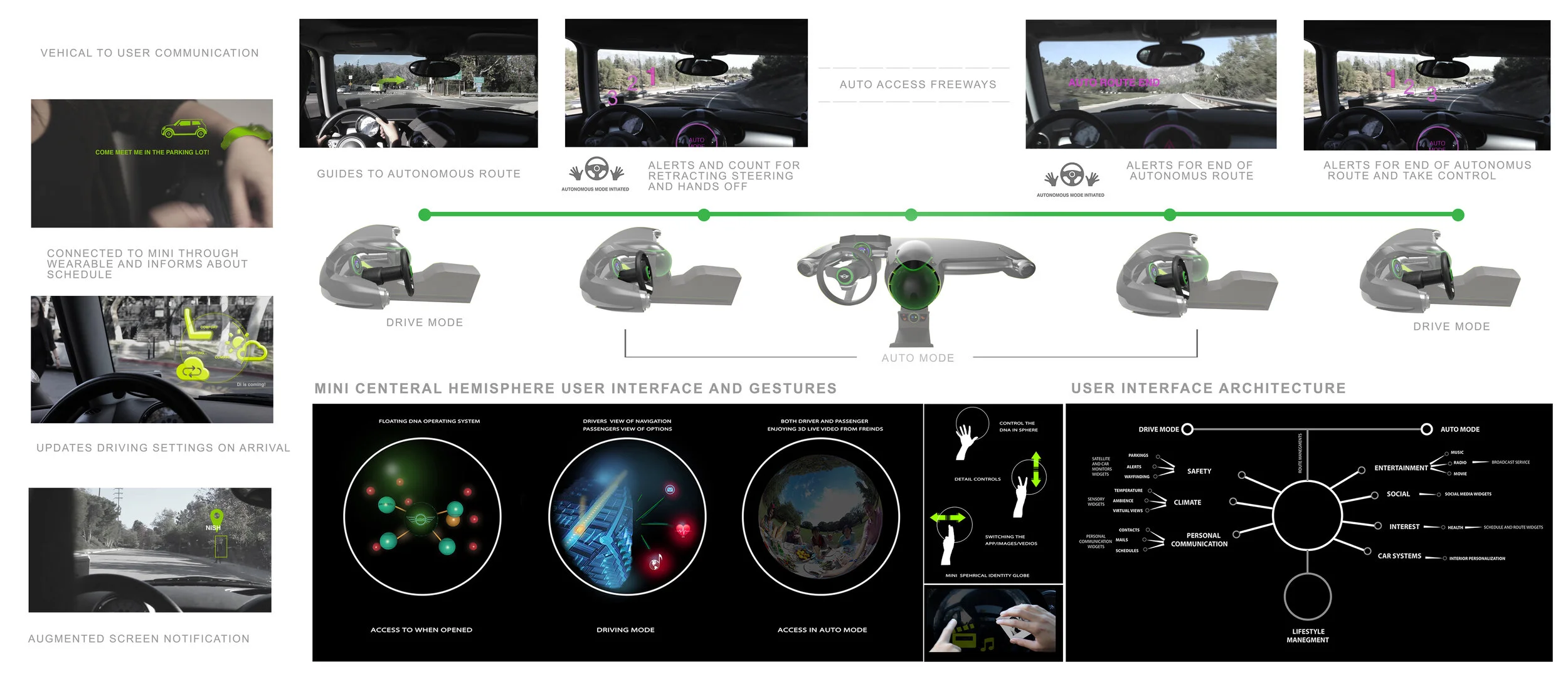
Vision Semi-Auto against the MINI and BMW of today
The benchmark is the all-new MINI Cooper, with its round OLED centre display, and BMW's Level 3 Personal Pilot. I'm not claiming a direct line from this project to either; the point is to test the 2015 thinking against what shipped.
Sources are numbered at the foot of the page.
Keep the sphere and the windshield split. Redesign the handover for the autonomy we actually got.
The round shared centre and the driver's own line of sight were the right pair, and MINI's production car shows what happens without the second half. The handover needs to be built for short, frequent, low-speed Level 2+ and Level 3 use.
- Readiness over countdownsUse driver monitoring to confirm eyes and hands before control returns, with a controlled-stop fallback.
- Design for hands-free Level 2 firstEyes on the road, hands off: the realistic near term. The sphere stays a passenger and media space.
- Multi-sensory takeover cuesHaptics in the seat and wheel, not only visuals, so the alert works when the driver is looking at the sphere.
- Measure time to takeoverRun takeover trials in a buck and track response time and errors, the same way I validated the Volvo fan knob.
Two habits that carried into my professional work
Test the interaction in a buck, with people
At Volvo I found the fan knob's detents didn't match the fan steps on screen. I validated a fix in a buck simulator with 15 participants, and the revised detents were carried forward.
One platform, many brand characters
At CARIAD I validated infotainment, digital clusters and connected experiences across VW Group's multi-brand HMI platforms, where each brand had to stay itself.
- Driving.ca via Yahoo: MINI reveals new design details, including a round touchscreen
- Parkers: MINI Cooper interior, tech and comfort
- Edmunds: MINI's new interior is full of fun details and nods to the past
- EVMagz: BMW Personal Pilot L3 on the 7 Series
- Electronic Design: BMW to offer Level 3 hands-off, eyes-off technology
- Autohaus: BMW steps back a level on highly automated driving (Feb 2026)
Level Four Autonomous Vehicle experience
Autonomous vehicles | In-vehicle experience | UX strategy
User Experience with Semi- autonomous BRAND BMW MINI
BACKGROUND
I created this project brief while working on the sponsored BMW vision project. In addition, this project was co-designed with three other designers. The project was worked on in a collaborative environment to strategize, design, and prototype the vision.
PROJECT
How can a brand evolve its identity in the connected-car era?
Role: Project lead, responsible for project experience and prototyping. I led the concept with a team of four designers, with research focused on technical and user experience aspects. I led the project direction and buck design, including center infotainment interaction and user experience.
Timeline: 2014-2015
End to End UXD PROCESS BELOW


